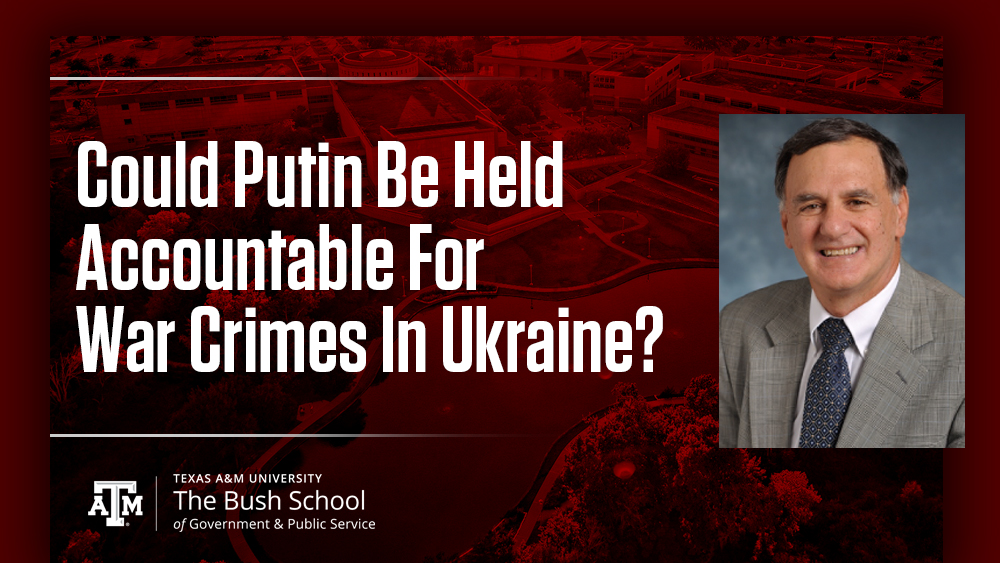
A Bush School expert says the mechanisms are in place, but the question is whether Russian President Vladimir Putin or his associates will ever stand trial.
As the war in Ukraine grinds on, a growing number of world leaders have stated that Russia’s actions amount to war crimes. President Joe Biden has now described the war as “genocide,” and a report published last week by the Organization for Security and Co-operation in Europe catalogs targeted attacks of civilians by Russian forces it says are clear violations of international humanitarian law.
Kremlin officials have categorically denied these claims. But as the evidence mounts, Texas A&M University Bush School expert Ronald Sievert says the public and officials should understand that despite misinformation, Russian President Vladimir Putin legally could be tried for committing war crimes by the International Criminal Court (ICC).
Prosecuting those crimes and holding Putin accountable would be complicated, but possible, he said.
Sievert is an associate professor of the practice at the Bush School of Government and Public Service, where he teaches national and homeland security law and international law. He previously worked in the U.S. Department of Justice, where he tried several major violent crime, corruption and fraud cases and worked on national security matters for 15 years.
He explains it’s a common misconception that because Russia and Ukraine are not parties to the ICC ─ one of the main international legal bodies that considers crimes of war ─ the court does not have jurisdiction. And because Russia has veto power as a member of the United Nations Security Council, it can prevent that body from taking action.
Despite this, Sievert said, there are still options that could result in an ICC trial.
First, ICC state parties can submit referrals supporting an investigation – 41 have already done so. The ICC prosecutor is also able to put the process in motion. In a commentary piece recently published in The Hill, Sievert describes how Putin can be held responsible under Article 28 of the ICC, which states that a commander is criminally responsible for crimes committed by forces under their control if they knew of, our should have known of, those actions.
“It’s almost impossible to imagine him not knowing what’s going on,” Sievert said.
“The veto has hampered the U.N. for almost its whole existence. For a country that is executing war crimes to use a veto to stop an investigation goes against what the entire U.N. charter was all about. That is a problem.”
Ronald Sievert
Because the ICC doesn’t try defendants if they’re not present at court, Putin could theoretically avoid trial – as long as he stays in power and remains in Russia.
“Of course, the practical question is, ‘Do you ever get Putin in your hands?’” Sievert said.
He said Putin is probably more exposed than he realizes: if there’s a change of government in Moscow, he could be handed over to the ICC. Otherwise, the political pressure that will be put on him in Russia would likely make it difficult for him to stay in the country. Western nations could also offer to lift sanctions in return for Putin being turned over, he said.
So while it’s currently unclear whether Putin will be tried by the ICC, Sievert points to the case of Slobodan Milošević, president of the former Yugoslavia, as an example of what’s possible.
Sievert said no one had expected Milošević would face charges for the war crimes committed in Europe when he presided over the Bosnian War, Croatian War of Independence and the Kosovo War, but “sure enough, when the government changed in Serbia, they handed him over and he was tried by the ICC.”
Milošević was charged with genocide, crimes against humanity and war crimes, but died in prison before a verdict could be issued.
In Ukraine, he said investigators will now be interviewing witnesses and gathering evidence to determine who is responsible for the killing of civilians in Bucha, Mariupol and other occupied cities – a process that could take a year or longer, Sievert said. They’ll try to determine which military officials gave the orders, and whether Putin knew the crimes were being committed.
“You cannot intentionally attack and kill civilians beyond a military necessity,” he said. “All of the information that has come out of Bucha about people being tortured and executed, that’s obviously a war crime. The total destruction of cities in the south, such as Mariupol, if beyond military necessity, is also a war crime. The other, potentially, is genocide, when you try to take out a population in whole or in part. That’s for a trial to determine, but when you start massacring civilians, it starts approaching genocide.”
Ukrainian President Volodymyr Zelenskyy is among those who has denounced the killings as genocide. As inquiries into possible war crimes across Ukraine continue, Sievert said Zelenskyy’s response is another important factor worth observing.
He points to the speech Zelenskyy gave to the U.N. Security Council last week after visiting Bucha. He urged the council to hold Russia accountable, or otherwise “dissolve.”
“He basically told the U.N., ‘If you can’t do anything, you might was well disband,’” Sievert said. “The veto has hampered the U.N. for almost its whole existence. For a country that is executing war crimes to use a veto to stop an investigation goes against what the entire U.N. charter was all about. That is a problem. Jennifer Trahan from New York University and other scholars are seriously raising the question whether the veto should always be used to prevent action when the veto is utilized by a state committing war crimes.”
By Caitlin Clark, Texas A&M University Division of Marketing & Communications
Note: This article originally appeared in Texas A&M Today on April 19, 2022