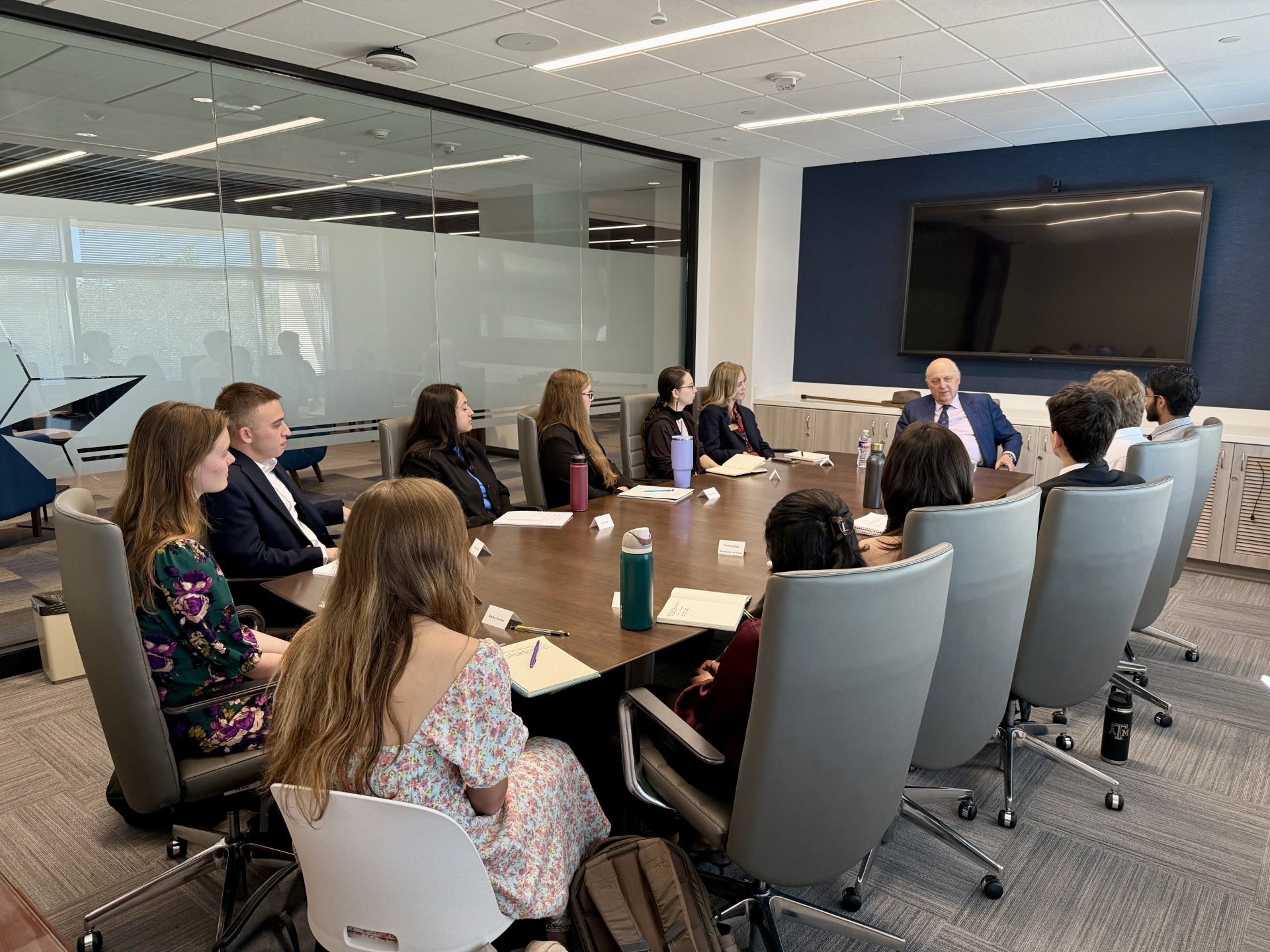
This year’s ConocoPhillips White House Lecture, on October 15, featured retired ambassador John Negroponte. Negroponte drew from his decades-long career in foreign service to reflect on former president Geoge H.W. Bush’s vision of economic diplomacy. The lecture was opened by John B. Sherman ’92, dean of The Bush School of Government and Public Service, and introduced by Alice Yates, CEO of the George & Barbara Bush Foundation.
Negroponte served as a U.S. ambassador to Honduras, Mexico, the Philippines, the United Nations and Iraq between 1981 and 2005. Under former president George W. Bush, he was also the first director of national intelligence (2005-2007) and the 15th United States deputy secretary of state (2007-2009). Notably, during his tenure as ambassador to Mexico (1989-1993) under the elder Bush, Negroponte was instrumental in creating and negotiating the North American Free Trade Agreement (NAFTA), which went into effect in 1994.
Negroponte began his lecture by reflecting on his personal connection with George H.W. Bush, noting that he had been classmates with William Henry Trotter “Bucky” Bush, the former president’s younger brother, at Yale University, and officially met the former president at an airport in Boston before Bush announced his run for the presidency. Negroponte recounted that their interactions became more frequent during his tenure as U.S. ambassador to Honduras, where he came to deeply admire Bush’s humanity and leadership.
When discussing his time as ambassador to Mexico and the early stages of NAFTA negotiations, Negroponte noted Bush’s natural understanding of the need for cooperation between the two countries, given their geographical proximity and intertwined economies. He explained that both he and Bush recognized that the import substitution model implemented post-World War II had benefited the Mexican economy. According to Negroponte, the stage was set for NAFTA by former Mexican president Miguel de la Madrid’s leadership in joining the General Agreement on Tariffs and Trade (GATT) in 1986. Then, under the elder Bush’s administration, when former Mexican president Carlos Salinas de Gortari expressed interest in a trade agreement with the United States, Negroponte actively facilitated mediation discussions and negotiations. Due to his key role in the process, Negroponte was requested to remain as ambassador to Mexico until NAFTA was created in 1993.
To close, Negroponte highlighted the skills, talents, decency and leadership that Bush brought to the public offices that he held, expressing deep admiration and gratitude for the opportunity to have worked with him.
During a conversation and Q&A session moderated by Raymond Robertson, Ph.D., director of the Mosbacher Institute, Negroponte answered questions regarding his journey in foreign service, impressions of Latin America and advice for students. He began by sharing his motivation to pursue a career in foreign service, inspired by his parents, who were very conscious about international issues and often discussed at home in New York, eventually joining the foreign service in October 1960. The Ambassador went on to share his impressions of Latin America, sharing his familiarity with the region given his educational background and passion for Latin American music fluency in Spanish. He also shared his exposure to multiple regional countries given his role as a marine fisheries negotiator which put him in contact with countries such as Costa Rica, Panama and Venezuela, besides Mexico.
Finally, Negroponte advised students to develop language proficiency and a deep understanding of geopolitical contexts for strong and successful careers in foreign service. He also expressed appreciation for meeting with Bush School and Economics students earlier that afternoon, noting his admiration for their interest in pursuing a career in international affairs during such challenging times.