
Texas has more than twice the national average rate of uninsured residents but has chosen not to expand Medicaid. Bush School faculty member Laura Dague estimated the impact Medicaid expansion could have in Texas.
At current funding rates, Medicaid expansion could bring in $5.4 billion in new federal dollars to Texas and provide health insurance coverage to nearly one million low-income Texans with little cost to the state. That’s according to a new detailed study on the impact of Medicaid expansion in Texas by Laura Dague, an Associate Professor and health economist at the Bush School of Government and Public Service, and Bush School student Constance Hughes. The authors also note that Medicaid can serve as an automatic stabilizer, providing federal dollars to states during economic downturns.
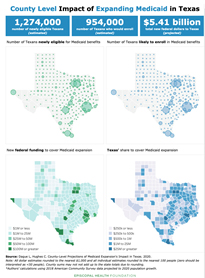
The results of their research are summarized in the latest issue of The Takeaway, “Medicaid Expansion’s Impact in Texas.” The work was sponsored by the Episcopal Health Foundation, a philanthropic organization focused on improving community health in Texas. The full report, “County-Level Projections of Medicaid Expansion’s Impact in Texas,” includes county-level data, interactive embeddable maps that show potential funding and health insurance coverage for every county in Texas, and complete details about the project’s methods.
“These new numbers show why Texans have told us they support Medicaid expansion—because it means more than one million people could have access to affordable medical services, including vital preventive care that’s more important than ever,” said Elena Marks, President and CEO of the Episcopal Health Foundation. “But this report also demonstrates that the benefits go beyond the uninsured to impact doctors, hospitals, and state and local governments.”
The Takeaway is a publication of the Mosbacher Institute for Trade, Economics, and Public Policy at the Bush School of Government & Public Service at Texas A&M University.