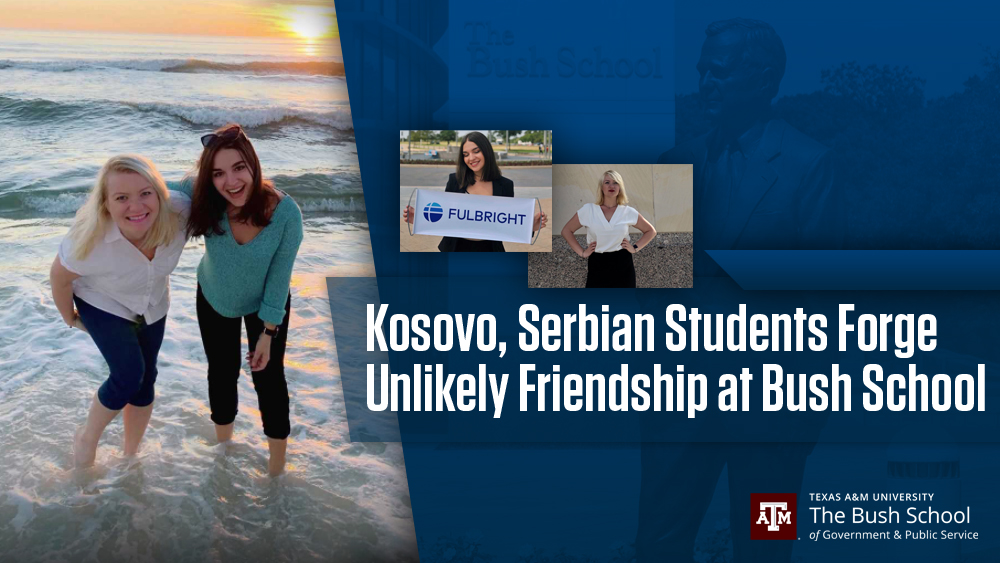
Anita Mitić and Vesa Bashota are Fulbright students studying at the Bush School of Government & Public Service at Texas A&M University. Mitić is pursuing her Master of International Affairs degree in national security and diplomacy; and Bashota, also in the Master of International Affairs degree program, is studying international development and economic policy.
By Anita Mitić and Vesa Bashota
Vesa Bashota, an Albanian from Kosovo, and Anita Mitic, a Serb from Serbia, currently live in Texas as Fulbright students. For most, we make for an improbable duo, but for us it was an instant connection that has weathered a pandemic, the first year of graduate school, two hurricane seasons, and a meeting between our two countries in the White House.
Soon after we first met at the Fulbright students’ orientation in Nevada, we went on a trip to attend a Texas-style Oktoberfest near San Antonio. We took an Uber, along with our American friend Tyler, and we were enjoying the scenery in silence. The ride was long, and the full moon was shining. Out of nowhere, Vesa said, “I swear, every time I look at the full moon from the car, I remember the night my family and I fled Kosovo during the war in 1999. I was only three years old, but I vividly remember looking at the moon and thinking, When will all this be over?”
That sentence opened a difficult and sincere conversation about our experiences during the war, with Vesa being in Kosovo at the onset and then escaping as a refugee, while Anita was in Belgrade during the bombing. There was something cathartic about this conversation, which strangely made us feel more connected than divided.
Understanding each other’s experiences and being able to empathize are at the heart of our unique friendship.
Understanding each other’s experiences and being able to empathize are at the heart of our unique friendship. When we arrived at the festival, Tyler was in awe, and our Uber driver confessed it was the most interesting conversation she had ever heard while driving.
BFFs, roommates with a twist
Having an instant connection and becoming best of friends instantly wasn’t strange for us. Anita has many Albanian friends and has been to Prishtina several times. Vesa is open to new people, regardless of their origins, and has worked with the Serbian community in Kosovo. Now both of us are known in school as an inseparable duo—or as our friends like to call us: Double Trouble.
For months, we laughed at people’s reactions when we’d tell them where we’re from. Some were shocked, some laughed, and some were visibly uncomfortable, but the general response was surprise.
After that initial trip, we began spending a lot of time together, bonding over highly inappropriate jokes, serious conversations about life and men, and our shared outlook on the peaceful future of the region. The problems we find ourselves in are so often similar, and that serves as a good reminder that we’re both human beings at the end of the day.
We spent a month traveling throughout the southern US without an argument. We’re convinced we jinxed 2020 because of all the fun we had on New Year’s Eve in Miami. Now we are roommates, and despite all the controversy surrounding our friendship, we make it work.
We are living proof that friendship based on not just accepting differences but exploring them and having open and honest discussions about what has happened in the past—all with a good dose of mutual respect—are possible.
Sometimes, we stay up late challenging each other’s opinions regarding politics between our countries—and those are not easy conversations to have at 2 a.m. … or ever. But being open-minded is key to understanding where those opinions are coming from. On the lighter side, we use a strange mix of English, Serbian, and Albanian words daily. In our apartment, it’s not unusual to hear something like: “Hey, check fijoka for the scissors.”
From the personal to the political
We don’t intend to draw parallels between our lives and the political situation between our countries. Clearly, things are much more complicated than a Serb and an Albanian finding a way to live together 10,000 km away from their homes. But we’d like to emphasize that given our long history of hostilities, the war in 1999, and today’s tense relations, the most likely scenario is that we would never meet. The far less likely scenario would see us become such close friends.
Our societies are so divided and disconnected that our story is worth telling. It would be a shame if such a friendship never occurred, and it wouldn’t have if Vesa weren’t open to befriending Serbs or Anita thought of Albanians in the way many others do in her country. None of this would exist, and our lives would be denied this beautiful, enriching friendship.
We are living proof that friendship based on not just accepting differences but exploring them and having open and honest discussions about what has happened in the past—all with a good dose of mutual respect—are possible. And maybe this is something our states should take into account when they’re sitting at the negotiating table. In a sense, our friendship represents what could be between our countries.
As another day in Texas comes to a close, Vesa retires to her room, saying, “Laku noć,” and Anita replies “Natën e mirë.”
This article was originally published by kosovotwopointzero.com
